What is recipe cost and why does it differ from the invoice?
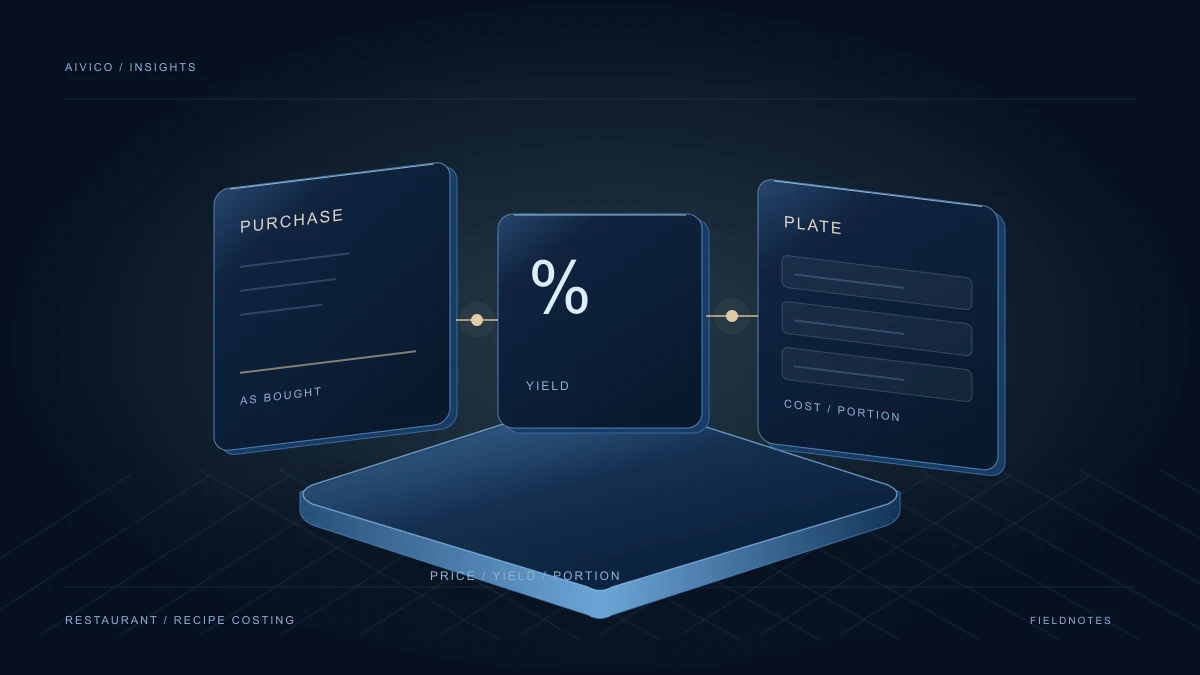
Recipe cost is the total cost of every ingredient used to prepare one portion of a menu item. It looks simple: multiply each quantity by its unit price and add them up. The catch is that the invoice price refers to the product as purchased. Bone-in meat, unpeeled vegetables and leafy herbs lose part of their weight during preparation, so the per-kilogram cost of what reaches the plate is higher than the invoice suggests.
That is why two prices need to be kept apart: the as-purchased price (unit price of the product as bought) and the usable cost (unit cost of what remains after trimming, cleaning and portioning). Using only the as-purchased price on a recipe card systematically understates cost—especially for meat, fish and fresh produce. Food cost looks healthy on paper while the expected margin never shows up in the till.
Yield: how to measure it in your own kitchen
Yield is usable weight divided by purchased weight. Usable cost is the as-purchased price divided by the yield. If a bone-in leg of lamb costs TRY 600 per kilogram and 70 percent is usable after trimming, the usable cost is 600 / 0.70 ≈ TRY 857 per kilogram.
Generic yield tables can be a starting point, but yield varies with supplier, product grade, cut and your team’s prep habits. The reliable method is a yield test: weigh several batches as purchased, prepare them with your standard method, then weigh the usable part and the trim separately. Record the result with the date and supplier, and repeat the test when the supplier or product changes.
Cooking loss is a separate matter. If recipe quantities are written as raw weight, cooking loss is already inside the recipe. If they are written as cooked portion weight, you also need the cooking yield. State on the recipe card which weight you use; counting the same loss in yield and again as waste inflates cost.
| Ingredient | As-purchased price (kg) | Measured yield | Usable cost (kg) |
|---|---|---|---|
| Bone-in leg of lamb | TRY 600 | 70% | ≈ TRY 857 |
| Dry onion | TRY 30 | 88% | ≈ TRY 34 |
| Parsley (bunch weight) | TRY 80 | 55% | ≈ TRY 145 |
Sample recipe card: build plate cost line by line
Each line on a recipe card should show the ingredient, quantity used, unit and usable unit cost. Line cost is quantity times unit cost, and the total is the plate cost. Rather than ignoring small quantities (salt, spices, oil), either list them or define a fixed ‘spices and oil’ allowance—otherwise every recipe ends up slightly under-costed.
| Ingredient | Quantity | Usable unit cost | Line cost |
|---|---|---|---|
| Lamb leg (trimmed) | 0.22 kg | TRY 857/kg | TRY 188.5 |
| Dry onion (peeled) | 0.05 kg | TRY 34/kg | TRY 1.7 |
| Butter pilaf (sub-recipe) | 1 portion | TRY 24/portion | TRY 24.0 |
| Parsley | 0.005 kg | TRY 145/kg | TRY 0.7 |
| Spices and oil allowance | fixed | — | TRY 4.0 |
| Plate cost | TRY 218.9 |
With a selling price of TRY 650 excluding VAT, this dish runs at a food cost of 218.9 / 650 ≈ 33.7%. Use price and cost on the same tax basis (both excluding VAT); mixing them moves the ratio by several points.
Sub-recipes: define sauces, doughs and prep items separately
Prep items such as pilaf, demi-glace, pizza dough or marinades are used in several dishes. Re-listing their ingredients inside every recipe is slow and leads to inconsistencies. The better method is to define each prep item as a sub-recipe with its own batch and yield: divide the total ingredient cost of a 5-kilogram sauce batch by the usable quantity it produces to get its cost per kilogram or per portion.
The main recipe then uses the sub-recipe as a single line. When the price of butter changes, the pilaf sub-recipe and every dish that uses it update together. Measure batch yield for sub-recipes too: what stays in the pot, is strained off or evaporates raises the real cost of the prep item.
Don’t forget modifiers, extras and takeaway packaging
The side a guest chooses, extra cheese, a larger portion or a sauce option all change plate cost. Adding these only to the selling price without linking them to the recipe hides the real margin of your best-selling combinations. Define the added or removed ingredient quantity for every option; reports should show cost with and without modifiers.
For takeaway, the box, lid, sauce pot, cutlery set and bag belong to plate cost. Delivery-platform commission should be tracked separately as a deduction from sales rather than as ingredient cost—but packaging belongs on the takeaway variant of the recipe. The same dish runs with a different cost and margin in the dining room and in delivery.
How to keep recipe cost current when prices change
In periods of high inflation, recipe cost can go stale within weeks. The most common problem with spreadsheets is that purchase prices get updated while recipes do not. Decide which price you cost from: last purchase price reacts quickly to changes, while weighted average cost reflects old and new batches in stock together. Apply the same choice across all recipes.
A practical routine: record the unit price at every goods receipt, flag ingredients whose price moved beyond a threshold, and list the new food cost ratio of every recipe that uses them. You may not need to change menu prices every time a supplier does—but knowing which item has drifted outside its target ratio turns portion, supplier and pricing decisions into data-driven ones.
- Record the quantity actually received and the unit price at goods receipt.
- List ingredients whose price moved beyond your threshold each week.
- Recalculate the recipes and sub-recipes that use them.
- Decide on portion, supplier or price for items outside the target food cost ratio.
- Repeat yield tests when the supplier or product changes.
Connecting recipe cost to inventory and sales
A recipe card is not only for pricing; it also drives expected inventory usage. If every portion sold deducts its recipe quantities from stock, you can compare theoretical usage with the stocktake at period end. When the recipe quantity differs from what is actually plated, the gap shows up in the count.
In Ordwell, product and option recipes, inventory movements and cost thresholds live in the same structure, so when an ingredient’s purchase price changes, the cost and margin impact on related products can be followed in one data flow. Pick a few items from your own menu and try setting up yield, sub-recipes and options together during a demo.