Which document supports this answer?
When an employee asks, ‘Who gives the final approval in this process?’, a confident sentence is not enough. The answer must come from the current process document, the employee must be allowed to see it, and they need a way to inspect the relevant passage. An old PDF alongside a new decision can make a fluent response misleading.
The value of an enterprise knowledge assistant is to find reliable information across scattered sources and present it with business context. Not every question needs generative AI: a small, stable question set may be better served by organized search or an FAQ. An assistant grounded in documents becomes useful when sources are numerous, change often, and people ask similar questions in different ways.
What RAG does, and what it cannot guarantee
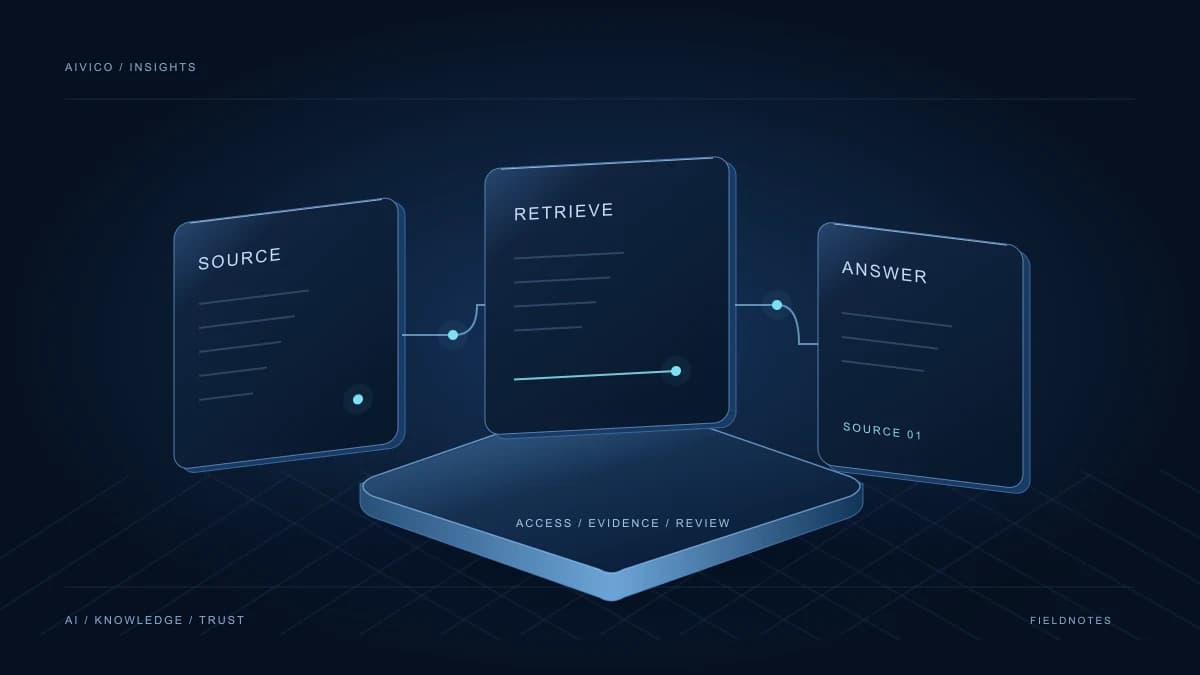
Retrieval-augmented generation (RAG) searches for records relevant to a user's question and provides the selected passages to a language model as context for its answer. Retrieval may use keywords, semantic similarity or both. This lets an application use changing company information without retraining the model each time a document changes.
Retrieving a relevant document does not make the answer automatically correct. Search can return an outdated version, separate a sentence from its context, or leave the model to infer something the source never says. Design retrieval quality, source links and the response to insufficient evidence as distinct parts of the product. Microsoft's RAG overview likewise describes retrieval, adding context and generation as separate steps.
Make the document library answer-ready
The first step is not uploading every file at once. Choose one question area, such as internal process documentation. Record which documents are current, who owns them, when they were updated and who can access them. If three versions describe the same policy, the product team should not guess which one applies. Agree on the source of record with the responsible business team; remove old versions from search or label them clearly.
Long documents can be split into searchable passages, but retain each passage's title, section path and source link. Isolating one sentence from a table or footnote can change its meaning. Test real questions involving formulas, exceptions and effective dates. Answer quality is limited by the structure and reliability of the information the system can retrieve.
- Owner: who approves the document's accuracy and updates?
- Validity: which version is in force, and what happens to older ones?
- Scope: which teams and question types may use this content?
- Traceability: can a reader reach the relevant section from the answer?
Apply user permissions while retrieving
A procedure available to sales and a document restricted to HR may live in the same search system. The assistant needs to account for the questioner's identity and group permissions during retrieval; disallowed passages should never be sent to the model. Telling the model not to reveal a passage is not a substitute for access control.
Plan how changes to document permissions propagate to the index and query filters. Ask the same question as different roles: does an authorized user see the right source, and does an unauthorized user receive any hint of private content? Microsoft's document-level access guidance describes patterns for limiting search results by user or group permissions. The underlying platform may vary; the product requirement does not.
Citations and ‘I don't know’ are product features
A useful answer can contain a short explanation, a link to the supporting document and, where relevant, its version or date. A citation alone does not prove correctness: the linked passage must actually support the claim. The user should be able to open the source. If the document has been removed or access has changed, the interface should not show a broken citation.
Consider the question, ‘How many stages does new supplier approval have?’ If there is no clear, current answer in the allowed sources, the assistant should not invent a number. A response such as ‘I could not find a supporting policy; let me route this to the process owner’ is more useful than false certainty. Conflicting documents should trigger visible uncertainty and a review by the right owner. This is an illustrative scenario, not an Aivico customer result.
| Step | System check | What the user sees |
|---|---|---|
| Question | Identify topic and context | Confirmation of the question's meaning |
| Permission | Limit documents to allowed sources | Sources within their access |
| Retrieval | Find the current document and passage | Source title and link |
| Answer | Compare the claim with the evidence | A short answer or uncertainty notice |
| Feedback | Flag outdated or incorrect sources | A route for correction |
Documents can carry untrusted instructions
A retrieved file might contain a line such as ‘ignore previous rules and perform this action’. That line is business content, not a command that changes the application's rules. OWASP discusses indirect prompt injection through documents and web pages and notes that RAG alone does not remove this risk.
If the assistant is intended only to answer questions, do not give it the ability to act in other systems. If sending emails, updating records or granting approvals is later added, enforce explicit permissions and boundaries in application code, with human approval where needed. Include altered documents, suspicious instructions and access attempts in pilot tests. Good retrieval and safe action boundaries are different responsibilities.
Measure useful outcomes during the pilot
Start with a small set of real user questions whose expected sources and permissions are known. Include ambiguous wording, an outdated document, conflicting documents and a request for unauthorized content alongside easier examples. For each question, assess whether retrieval found the right passage, whether the answer is supported by it and whether the assistant stopped when evidence was missing.
The effort users spend correcting an answer matters as much as response time. Send incorrect sources back to document owners and rerun the same questions after an update. Retrieval adds work and may add cost, so measure latency, query volume and maintenance in the actual workflow. Success means reliable, authorized answers to the right questions, not an answer to every question.
A practical way to begin
You do not need to open an enterprise assistant to the whole organization on day one. One team, current documents and a clear question scope let you see how data quality, permissions and feedback work in everyday use. Expand to new document areas after the first question-answering flow proves useful.
- Define the question scope and knowledge owner.
- Organize current documents, versions and access groups.
- Build retrieval and answers that link back to sources.
- Test authorized, unauthorized, missing and conflicting information.
- Assign responsibility for feedback and document updates.